The Laptop Lifestyle Lie: Why Most Cam Models Can't Actually Travel While Working (And What It Really Takes If You Want To)
You've seen the posts. Some cam model casually mentions she's streaming from Thailand this month, then Bali next month, living the dream on $200/month rent while you're stuck paying $1,400 for a one-bedroom you barely leave because you work from home anyway.
You've got the most location-independent job in the world. Literally just a laptop and an internet connection. So why aren't you doing it?
Turns out, there's a reason most cam models never leave their home base. And it's not just the cat.
The Math Doesn't Math (For Most Of Us)
Here's what nobody talks about: unless you're willing to fully give up your home base, you're paying for TWO places to live.
That $1,400 apartment? It doesn't magically disappear just because you're in Chiang Mai for a month. Your lease keeps running. Pet sitter still needs to get paid. And that storage unit for all the toys and equipment you couldn't pack? Yeah, that costs money too.
So yeah, that $200/month studio in Southeast Asia sounds amazing until you do the actual math. You're paying $1,600/month total. Plus flights. Plus all the portable equipment you had to buy because your full streaming setup doesn't exactly fit in a carry-on.
The models who actually make nomadic camming work financially? They went all in. Gave up the lease completely. Put everything in storage or sold it. They committed to at least 6-12 months of full-time travel because that's the only way the numbers work.
Which brings us to problem number two: most cam models can't afford to take that kind of financial risk.
The Income Inconsistency Problem
You know what makes giving up your apartment and committing to 6+ months abroad absolutely terrifying? The fact that you made $4,000 last month and $600 this month.
Camming income is volatile as hell. Your top tipper disappears. The algorithm changes on a whim. You get sick for a week and lose all your momentum. Or your new girl tag expires and suddenly you're getting a third of the traffic you used to.
When you have a home base, you can ride out the slow months. You've got your emergency fund. You can pick up extra shifts. Hell, you can stress-eat ice cream on your couch with your perfect lighting setup that took you six months to dial in.
When you're in a foreign country with inconsistent income? That's when the panic sets in. You're refreshing your bank account every hour wondering if you have enough for a flight home. That's when the dream becomes a nightmare real quick.
The models making it work have 6+ months of expenses saved. Minimum. They're not living paycheck to paycheck hoping Bali's cheap enough to cover it.
Beyond just camming, the most resilient models diversify their income streams. As discussed in The Multi-Streaming Trap: Why Broadcasting on 4 Sites at Once Gets You $150/Day Instead of $500 (And the Strategic Split That Actually Works), spreading your work strategically across multiple platforms gives you way better stability than putting all your eggs in one basket.
The Passport Privilege Nobody Mentions
Here's something wild: all the digital nomad advice just assumes you have a US, UK, or EU passport.
Just hop to Thailand for 3 months! Then Vietnam! Then Bali! So easy!
Unless you're from Colombia. Or the Philippines. Or Russia. Or dozens of other countries where you need to apply for visas weeks in advance, provide bank statements, show return flights, and sometimes get rejected anyway.
The 'strong passport' privilege is incredibly real. If you can't just show up and get 30-90 days visa-free in most countries, the whole digital nomad thing becomes exponentially harder.
And nobody talks about it because the people writing the blog posts and making the YouTube videos about traveling while camming overwhelmingly have that privilege.
The Legal Stuff That Could Actually Ruin Your Life
Here's the part that should terrify you more than slow income: sex work is illegal in a lot of the popular digital nomad destinations.
Thailand? Technically illegal. Vietnam? Illegal. Malaysia? Very illegal. Indonesia (including Bali)? Also illegal.
Now, enforcement varies wildly. Plenty of models cam from these countries without issues. But the risk is real. Getting caught could mean:
- Immediate deportation
- Being banned from returning to that country
- Actual jail time in some places
- Your equipment confiscated
- The whole situation becoming public record
Is it likely? Probably not. Most models never have issues. But the downside risk is catastrophic in a way that doesn't exist when you're camming from your apartment in the US or EU.
The models who travel smart actually research the laws, not just what some random blog post says. They choose destinations carefully. They have exit plans. And they definitely don't broadcast their location in real-time.
The WiFi Roulette You Can't Afford To Lose
You know what kills more digital nomad dreams than anything else? Internet that the listing says is 'fast' but actually can't handle a video stream.
You book 2 weeks in an Airbnb. Host says the WiFi is great. You show up, test it, and get 3 Mbps upload. Completely unusable for camming.
Now what? You're locked into a booking. Losing income every day you can't stream. You're scrambling to find a new place, but you don't know the area, and you can't verify the WiFi until you're already there.
Hotel WiFi is universally trash for streaming. Shared accommodations are a total gamble. Even 'digital nomad friendly' places sometimes can't handle the upload requirements for HD video.
The models who make it work:
- Message hosts beforehand asking specific questions about upload Mbps
- Read reviews obsessively looking for mentions of internet quality
- Book private apartments, never shared spaces
- Have a backup plan like a portable hotspot or knowing where the nearest coworking space with good internet is
- Test the internet the second they arrive, while they still have time to find an alternative
But even then, it's a risk every single time you change locations. Your home setup doesn't have this problem.
The Loneliness Nobody Warns You About
Here's the thing about being a digital nomad as a cam model: you can't tell anyone what you actually do.
You meet other travelers. They seem cool. They invite you to join their coworking session. They ask what you do.
And you lie. 'Content creator.' 'Online marketing.' 'Freelance stuff.'
They want to grab dinner at 8pm but that's your prime streaming time. They suggest joining their coworking space but you obviously can't cam in public. They think you're being weird and distant when really you're just trying to maintain boundaries around work that requires absolute secrecy.
At home, you might have a support system. Friends who know what you do. Other models you can actually vent to. A routine and community.
On the road? You're isolated in a way that's hard to explain until you've lived it. Beautiful location, exciting city, and you're spending 6 hours a day locked in your apartment with the curtains drawn talking to strangers on the internet. Then you go outside and can't be honest with anyone you meet about what you actually do.
Some models handle this fine. Others end up lonelier traveling than they ever were at home. The emotional labor involved in maintaining these boundaries while traveling mirrors what's discussed in The Accidental Therapist: Why Your Cam Room Turned Into a Crisis Hotline (And How to Get Paid for Emotional Labor) - except now you're managing that labor while completely cut off from your support system.
The Equipment Minimalism You're Probably Not Ready For
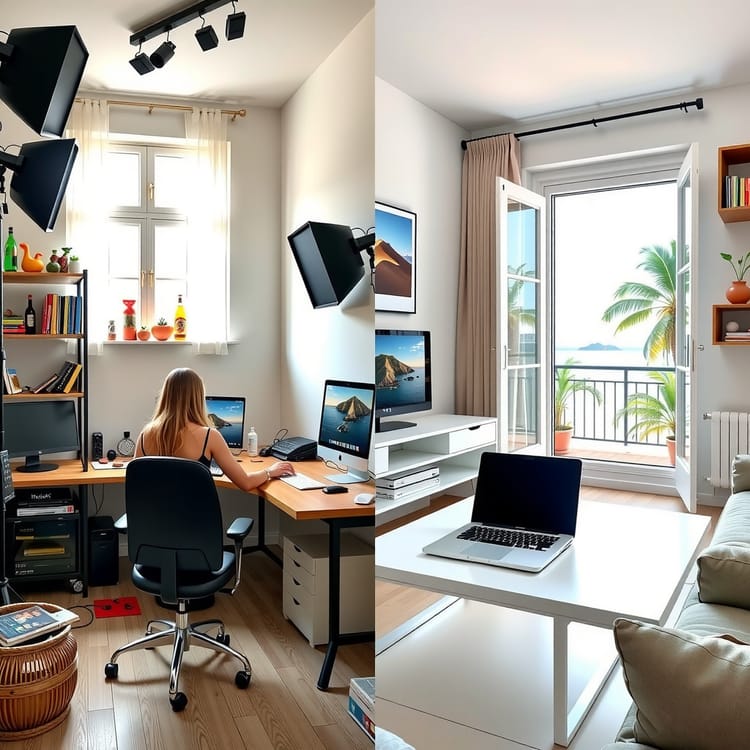
At home you've got: the perfect lighting setup, three different angles dialed in, 12 toys organized by type, your favorite chair, the backdrop you spent $200 on, your full wardrobe, every prop you could possibly need.
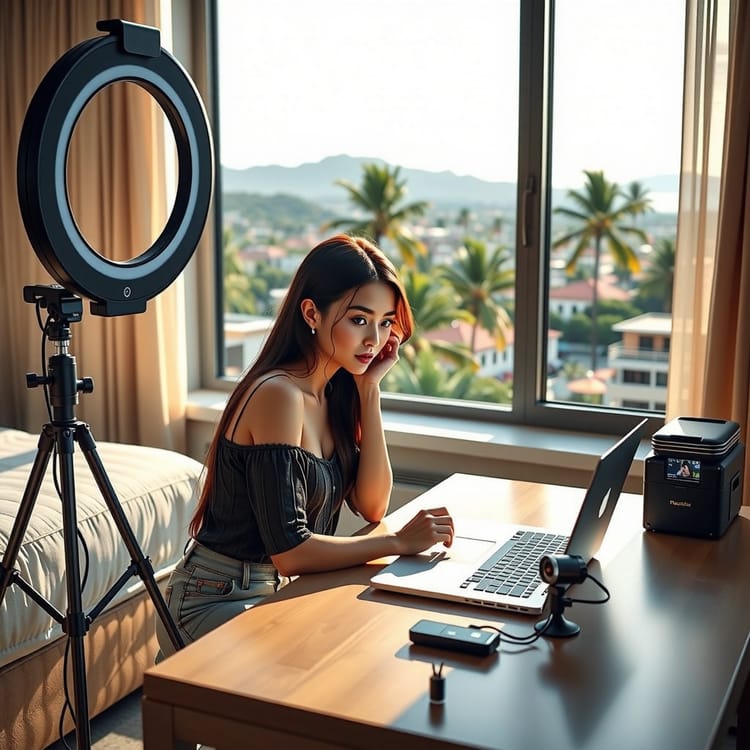
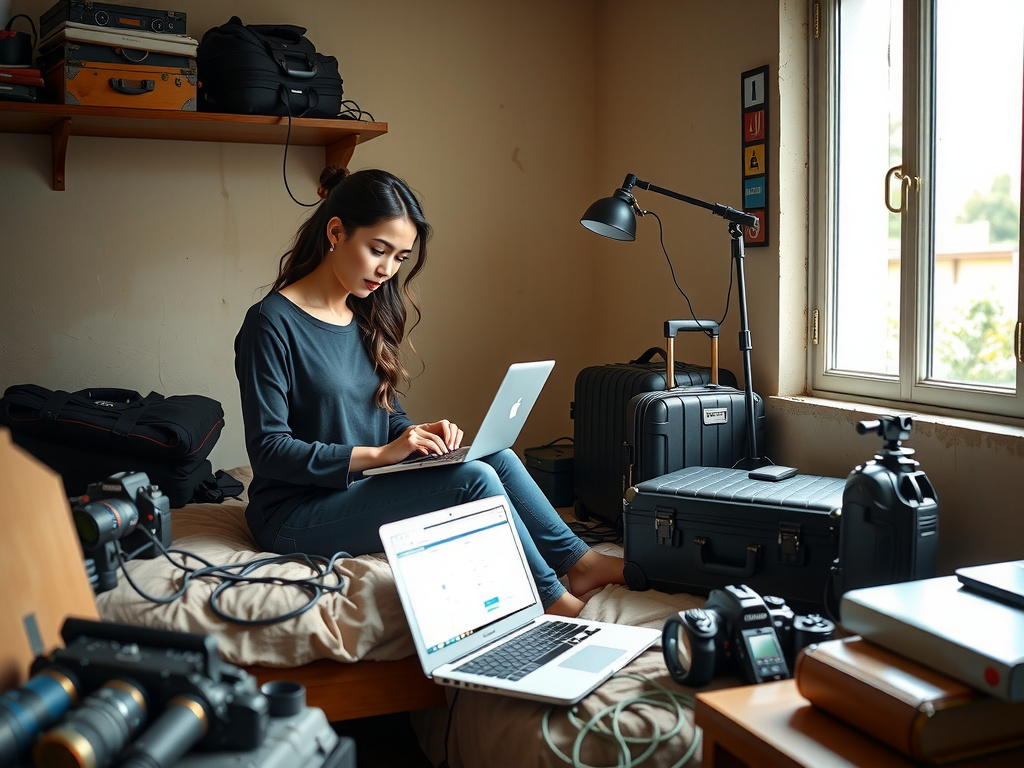
For travel you've got: your laptop, one portable ring light, maybe two toys max, and whatever you can fit in a suitcase while keeping it subtle enough that TSA doesn't pull you aside for the world's most embarrassing bag check.
Your whole performance changes. Can't do the shows you're known for. Can't offer the variety your regulars expect. You're working with hotel room lighting and a desk chair that's wrecking your back.
Some models adapt and get creative with it. Others watch their income drop because they just can't deliver the same quality show they do at home.
And every time you change locations, you're starting from scratch. New room layout. New lighting situation. New noise concerns. It's exhausting in a way that's hard to appreciate until you've spent 2 hours trying to get decent lighting in your fifth Airbnb of the month.
So Who Actually Makes It Work?
Okay, so if it's this hard, who are the models successfully pulling off the nomadic cam life?
They're the ones who:
Have 6-12 months of expenses saved minimum. Not just for travel, but as a safety net for when things inevitably go wrong. Because things WILL go wrong.
Fully committed by giving up their home lease. No half-measures paying for two places. They went all in because that's literally the only way the math works.
Have diversified income streams. They're not just camming. They've got clip sales, a fansite, phone sex, customs - multiple revenue sources so if one dips, they're not completely screwed.
Treat it like work, not vacation. They maintain a strict schedule. They're not out partying every night. They picked travel BECAUSE they could make it work with their existing work ethic, not hoping travel would somehow make work easier.
Stay in each location for at least a month. They're not city-hopping every week. They're slowing down, establishing routines, finding their rhythm in each place before moving on.
Have the personality type that handles uncertainty well. If unexpected problems send you into a spiral, if you need stability and routine to function, if you get anxious easily - the nomad life might genuinely not be for you. And that's completely okay.
The Unsexy Advice If You Actually Want To Try This
If after all this you still want to try traveling while camming, here's the reality-based approach:
Don't quit your lease for the first trip. Test it for 1-2 months while keeping your home base. Yes, it's expensive. But it's way less expensive than giving up your apartment, going abroad, realizing you hate it, and having to scramble for new housing when you get back.
Do the actual math on cost of living. Don't just look at rent. Calculate everything - accommodation, food, coworking spaces if needed, visa fees, flights, travel insurance, equipment you need to buy, the income you'll likely lose during transition periods. Be brutally honest about whether you'll actually save money or if you're just romanticizing the idea.
Save way more than you think you need. The recommendation is 6 months of expenses. Make it 9-12 if you can. This money is for emergencies, slow months, flights home if everything goes sideways, and the peace of mind that lets you actually enjoy travel instead of constantly stressing about money.
Research internet obsessively. This is your business's most critical infrastructure. Message every Airbnb host asking about upload speeds specifically. Read every review. Check if other digital workers mention the internet quality. Have a backup plan. Know where the coworking spaces are. Look into portable hotspot options.
Actually research the laws. Not just what a travel blog says. Look up the actual legal status of sex work in your destination countries. Understand the risks. Make informed decisions. Have an exit strategy if things go sideways.
Test your entire setup immediately when you arrive somewhere new. Don't wait until your first scheduled stream. The second you get to your accommodation, set up everything, test your internet, check your lighting, make sure your cam site isn't blocked. If there are problems, you need to know while you still have time to fix them or find a different place.
Pack like a minimalist professional. One ring light. One or two versatile toys. One good microphone. Your laptop. A webcam if you use an external one. That's it. Everything else is weighing you down and making you conspicuous. Learn to work with less.
Maintain work discipline. Set a schedule and stick to it. Don't let being in an exciting location become an excuse to skip streams. The models who succeed abroad are the ones who treat it like they're still working a job, because they are.
Consider time zones strategically. Being in Southeast Asia while your audience is in North America means you might stream during local daytime and sleep at night. Or you flip your schedule completely. Think through how this actually works before you book a ticket.
Never share your real-time location publicly. Post about places after you've already left. This isn't just about stalkers - it's also about legal protection, personal safety, and maintaining some privacy in a job that already exposes so much.
The Bottom Line
Most cam models don't travel while working because it's genuinely harder, riskier, lonelier, and more expensive than staying put.
The digital nomad lifestyle isn't some obvious upgrade everyone should be doing. It's a specific choice with specific tradeoffs that make sense for some people and absolutely don't for others.
If you've got stable income, significant savings, strong passport privilege, good risk tolerance, comfort with uncertainty, and genuine desire to travel rather than just escape - then yeah, it might work for you.
But if you're thinking about it because you're romanticizing the idea or because Instagram makes it look easy - you're probably going to spend a lot of money learning this the hard way.
There's nothing wrong with staying where you are, optimizing your home setup, building your income, and taking normal vacations where you actually disconnect instead of trying to work. That's not settling. That's being smart.
The laptop lifestyle works for some. For most, it's just an expensive way to make your job harder while pretending to other travelers that you do affiliate marketing.
Choose accordingly.