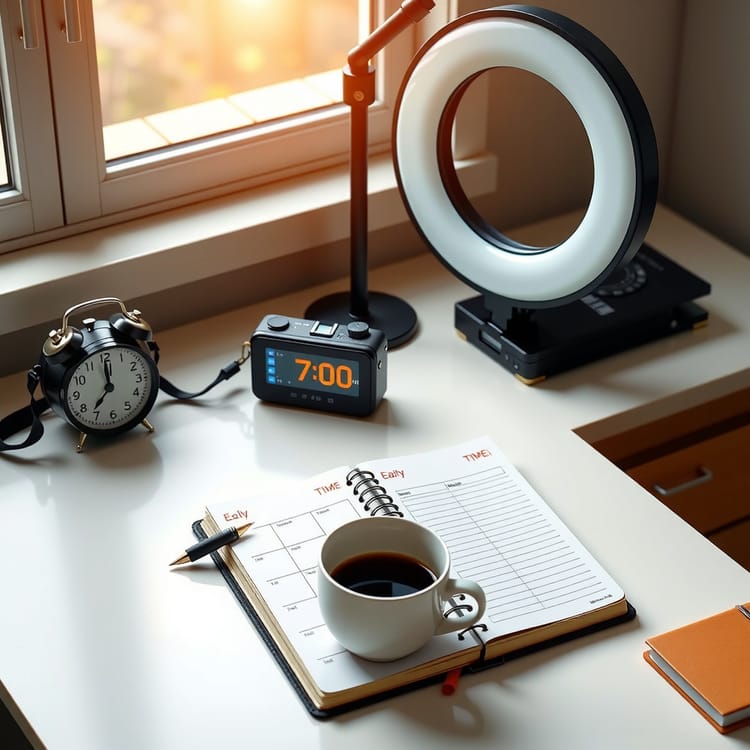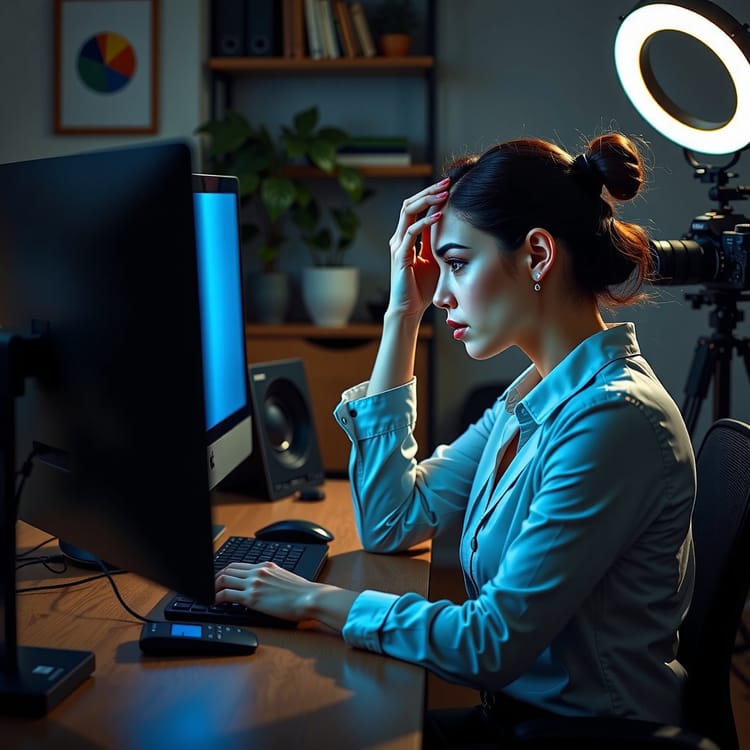
The Free Time Paradox: Why Cam Models with 'Dream Schedules' Feel More Lost Than 9-5 Workers (And the ADHD Executive Dysfunction Connection)

You log off after a 3-hour stream. You made $300. Your rent's covered for the week. The entire rest of your day - hell, your entire life - stretches out in front of you, completely free.
So why do you feel like you're drowning?
You scroll through your phone. Clean the kitchen again even though it's already spotless. Rewatch the same show for the third time this week. Check if anyone's tipped offline. Your friends are all stuck at work. Your partner won't be home for another 6 hours. The silence is absolutely deafening.
And then that familiar thought creeps in: Maybe I should just log back on.
Welcome to the free time paradox - that weird, counterintuitive nightmare where having unlimited time somehow makes you feel more trapped than a 40-hour workweek ever did.
The 'Dream Schedule' That Became a Psychological Prison
When you first started camming, the pitch was absolutely intoxicating: Work when you want. Make your own hours. Be your own boss. For those of us who came from soul-crushing 9-5 jobs, it sounded like pure freedom.
And at first? It really was. You could sleep in. Work a few hours. Make more money than you ever did in retail or food service. You finally had time to yourself - time you'd been craving for years.
But then something strange started happening. That freedom began to feel less like liberation and more like... quicksand.
One model on Reddit described it perfectly: "I usually work from 9am-noonish and then again from 8pm-11 some nights. So most of my day is pretty free. I've found some hobbies I enjoy but I mostly find myself cleaning the house or just deciding to get on cam again since I have nothing else to do."
She works maybe 6 hours a day, tops. She makes good money. And she feels completely lost.

Why Having Too Much Time Is Actually Worse Than Having None
Here's what nobody tells you about unlimited free time: Your brain actually needs structure. Not because you're weak or lack discipline, but because that's literally how human psychology works.
Think about it. When you worked a 9-5, your day had automatic boundaries built in. You woke up at 7am because you had to be somewhere at 8. You ate lunch at noon because that's when your break was. You saw friends at 6pm because that's when everyone got off work. You crashed at 11pm because you had to wake up at 7 the next morning.
Those external structures did something really crucial: They made decisions for you. They created natural stopping and starting points. They synced your life with everyone else's lives.
When you cam, all of that just... disappears. You can wake up whenever. Work whenever. Eat whenever. Sleep whenever. Every single decision is now YOUR decision. And that's exhausting in a way that's really hard to explain to people who've never experienced it.
One model put it this way: "I've also found this job to be very isolating. I have friends that I try to see regularly but they're busy with their own lives. I'm starting to wonder if maybe I should get a part-time job just to have somewhere to go and people to see."
Think about that for a second. She's financially successful enough that she doesn't need another job. But she's considering getting one anyway because the isolation of unlimited free time is literally destroying her mental health.
The ADHD Connection: When Executive Dysfunction Gets WORSE with Success
If you have ADHD - diagnosed or not - the free time paradox hits even harder. Like, exponentially harder.
Multiple models have reported that their ADHD symptoms got significantly worse after becoming successful cam models. Not because the work itself is hard, but because the lack of external structure removes all the scaffolding their brains were relying on to function.
When you have ADHD, external deadlines, appointments, and commitments act like training wheels for your executive function. Your boss expects you at 9am? That forces you to wake up. Meeting at 2pm? That creates a natural anchor point in your day. Class every Tuesday and Thursday? That's structure you don't have to create yourself.
Remove all of that, and suddenly you're staring at a completely blank calendar with zero external pressure to do anything. And paradoxically, that makes it HARDER to do literally anything.

The research actually backs this up. People with ADHD often struggle way more with unstructured time than structured time because their brains don't naturally create internal organization. Without external scaffolding, everything feels equally urgent (which means nothing feels urgent) or equally unimportant (which also means nothing feels important), leading to complete paralysis.
And camming adds another layer to this: The dopamine hit.
The Dopamine Trap: Why Nothing Else Feels Worth Doing
Camming provides something most jobs don't: Immediate, variable rewards. Tips come randomly. Some nights you make $50 in an hour, other nights you make $500 in 30 minutes. That unpredictability creates this powerful dopamine response - literally the same mechanism that makes gambling addictive.
And if you have ADHD? Your brain is already chronically low on dopamine. Camming becomes the most stimulating thing in your life by a massive margin.
One model nailed it: "Having unlimited time makes it harder to commit to anything because nothing feels as stimulating as the immediate dopamine from streaming."
Want to take a yoga class? That's 90 minutes of low-stimulation activity with no immediate payoff. Want to read a book? Same problem - no instant gratification, just delayed satisfaction that your ADHD brain doesn't really compute. Want to learn a new skill? That requires sustained focus with no immediate reward.
But logging onto cam? That could mean money RIGHT NOW. A tip notification. A private request. Instant validation. Immediate stimulation.
So you log on. Not because you need the money. Not because you have the energy. But because your brain is literally screaming for dopamine and this is the easiest way to get it.
And that's how the paradox becomes a trap.
The Social Mismatch: Everyone You Love Is Busy When You're Free
The isolation isn't just internal - it's structural, built right into the fabric of how society operates.
Your friends work 9-5. Your partner works 9-5. Your family works 9-5. Hell, society basically runs on a 9-5 schedule.
You're free from 10am-8pm - exactly when everyone else is unavailable.
As one model wrote: "Friends are all at work. Your partner won't be home for 6 hours. The silence is deafening."
This creates this really vicious cycle:
- You have tons of free time during the day
- But literally everyone you know is working
- So you fill that time with... nothing productive, really
- Which makes you feel guilty and even more isolated
- So you log back onto cam just to feel connected to something
- Which means you're too exhausted to socialize when people ARE finally available
- Which makes the isolation even worse
Dating becomes especially complicated. Multiple models mentioned worrying about being 'up their partner's ass' because they have so much more free time than someone with a traditional job.
When your partner leaves for work at 8am and doesn't get home until 6pm, what do you even do with those 10 hours? If you text them throughout the day, you feel clingy. If you don't, you feel disconnected. There's literally no winning.

The Guilt Cycle: When Success Makes You Feel Like a Failure
Here's the cruelest part of all this: You feel guilty for feeling bad.
Multiple models described feeling 'abnormal or ungrateful' for struggling with their dream schedule. They have what everyone wants - freedom, money, time - so why the hell aren't they happy?
The guilt just keeps compounding:
- You feel bad about having too much free time
- Then you feel bad about feeling bad when others would literally kill for your schedule
- Then you feel bad about not using your free time 'productively'
- Then you feel bad about still being exhausted despite 'doing nothing all day'
Productivity culture has trained us to believe that rest is only earned through exhaustion. If you're not grinding 60 hours a week, you don't 'deserve' to be tired. If you have free time, you should be using it to optimize yourself - learn a skill, build a side business, work out, meal prep, network.
But emotional performance - which is what camming fundamentally is - exhausts you in a way that's invisible to others and hard to justify even to yourself.
You worked 3 hours. You didn't do anything physically demanding. But you spent those 3 hours regulating your emotions, performing enthusiasm, managing dozens of interactions, and staying hypervigilant for boundary violations.
That's exhausting. But it doesn't look like exhaustion to the outside world. So you feel like you're making it all up.
What Actually Helps: Strategies That Work
The good news? You're not broken, and this is absolutely fixable. The bad news? The solutions are completely counterintuitive. But many cam models have found real relief by seeking structure through external commitments, pursuing ADHD evaluation when symptoms align, and reframing rest as legitimate recovery rather than laziness. For practical daily strategies, check out our guide on building micro-routines for unstructured schedules.
1. Create External Structure (Even If You Don't Need To)
Multiple models reported that taking classes - community college, language learning, yoga, literally anything - was completely transformative. Not because they needed the skill, but because it created automatic structure they didn't have to think about.
Class at 2pm on Tuesdays and Thursdays means you HAVE to shower, leave the house, and interact with actual humans. That simple external commitment can anchor your entire week in a way nothing else can.
Other options that actually work:
- Volunteer work (scheduled shifts that force you out of the house)
- Part-time job doing something really low-stakes (coffee shop, bookstore, library)
- Gym membership with scheduled classes (not just 'I'll go when I feel like it')
- Weekly therapy or support groups at the same time each week
- Standing friend dates (like every Wednesday lunch, every Friday evening, etc.)
The key here is that the structure has to be EXTERNAL. Telling yourself 'I'll work out 3 times this week' doesn't work because there's no accountability. Signing up for a class that happens at a specific time works because someone else is expecting you to show up.
2. Consider ADHD Evaluation and Treatment
Multiple models reported that getting diagnosed and treated for ADHD in their 30s was 'life changing.' This connects directly to why executive dysfunction worsens when external structure disappears - our earlier discussion on the ADHD connection explains this whole phenomenon deeply.
If you:
- Struggled with executive function even when you had structure
- Find yourself paralyzed by too many choices
- Can't seem to start tasks even when you genuinely want to
- Hyperfocus on camming but can't focus on literally anything else
- Feel like your symptoms got WORSE once you removed external structure
...it's worth getting evaluated. ADHD medication won't solve the isolation problem, but it can dramatically help with executive dysfunction, making it way easier to actually DO the things you want to do with your free time.

3. Reframe Rest as Productive
One model said something really profound: 'Accept that rest IS productive - reframe downtime as necessary recharging, not laziness.'
Emotional labor is real labor. Performing on cam - even for just 3 hours - is real work. Just because you're not physically exhausted doesn't mean you're not legitimately tired.
You don't need to fill every waking hour with optimization. It's okay to watch TV. It's okay to scroll Reddit. It's okay to take a nap at 2pm on a Tuesday.
The guilt you feel about having free time? That's capitalism talking, not reality. You're not lazy. You're recovering from emotional performance work, and that takes real time.
4. Find Low-Stakes Social Connection
The isolation hits harder when your only social interaction is either (a) emotionally draining cam shows or (b) scheduled hangouts that require energy you just don't have.
Several models found real relief in:
- Online communities with async communication (Reddit, Discord) where you can interact without performing
- Text-based platforms like SextPanther that provide income and connection but are way less emotionally draining than streaming
- Becoming a regular at a coffee shop or library (low-pressure social presence)
- Walking groups or hiking meetups (social but with the focus on the activity)
- Getting a pet (not a replacement for human connection, but it helps with daily structure and breaks isolation)
The key is finding social connection that doesn't require you to perform or explain your job or justify your schedule to people who don't get it.
5. Create Micro-Routines
Since you don't have macro-structure (like a job that starts at 8am sharp), create micro-structure through small daily rituals:
- Morning walk before you're allowed to check your phone
- Coffee at the same cafe every single day
- Library visit at 2pm (read, work on your laptop, doesn't matter - just go)
- Dinner prep at 5pm every day (gives you something to do during that lonely 'everyone's getting off work but I'm still home alone' time)
These don't need to be productive activities. They just need to create anchors in your day that force you to engage with the world outside your apartment.
6. Consider Diversifying Income Streams
Multiple models found that adding text-based platforms significantly reduced the isolation while maintaining their income.
One model reported making $800 on SextPanther through texting and videos alone - no streaming required. Another said: 'I would rather have monthly money that is somewhat stable instead of the ups and downs of camming.'
Texting is way less emotionally draining than live performance. You can respond when you actually have energy. You're not trapped in a 3-hour performance window where you have to be 'on' the whole time.
Some models also found that OnlyFans or Fansly provided more stable income with less emotional exhaustion: 'I make up to $2,000 on OnlyFans... through sexting. A lot of sexting.'
The Bottom Line: You're Not Ungrateful, You're Human
If you're reading this and thinking 'holy shit, that's me' - you're not alone. Not even close.
The free time paradox is incredibly real. Having unlimited time can be just as psychologically destabilizing as having none at all. The isolation is profound. The executive dysfunction gets worse, not better. The dopamine dysregulation makes everything else feel flat and pointless.
You're not broken. You're not lazy. You're not ungrateful.
You're a human being whose brain was literally designed to function within social structures, and you've removed most of those structures in pursuit of freedom. That comes with trade-offs. And those trade-offs are completely legitimate.
The solution isn't to go back to a 9-5 job you hated. It's to recognize that complete freedom actually requires you to build your own scaffolding - and that's hard work, but it's absolutely doable.
Create external structure. Get evaluated for ADHD if this resonates with you. Reframe rest as productive recovery. Find low-stakes social connection. Build micro-routines into your day. Consider diversifying your income streams to reduce performance exhaustion.
And most importantly: Stop feeling guilty for struggling with a problem that society tells you isn't real.
Your struggle is real. Your isolation is real. Your exhaustion is real.
And you deserve support, not judgment.